When writing this, I haven’t started doing the Archon Quest v7.1 🫠
Recently, there were a lot of Genshin Impact memes that have scattered across my Twitter timeline regarding the latest Archon Quest, which depicted and symbolized Vodyanitsa among these great figures.
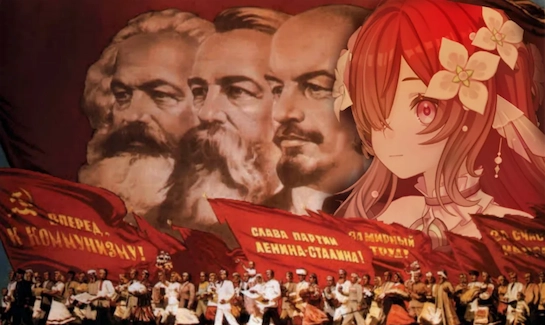
The thing that always struck me when I started playing Genshin back then was: it surely DOES, and always can be reinterpreted around socialism, revolution, and leftist themes. For instance, during the Inazuma quest back then, the great Kokomi was trying to revolt against the Almighty Raiden Shogun. One of the things was the Vision Hunt Decree. During a journey to Sumeru, the main quest focused on overthrowing the authoritarian regime that resurfaced among the Akademiya higher-ups.
When the Traveler’s journey reached the seventh nation, Snehnaya, I couldn’t even be surprised (anymore) if most of the conversations were related to the low wages, work environment inequality among NPCs, start questioning and barking at Heavenly Principles, and such. Although I’ve been observing, lately the dialogue has been quite horrendous, inconsistent, and slop, but that’s a different discussion. < Never mind about that, lol >
What intrigued me is not about HoyoVerse being socialist or telling us that they were fully socialism/leftist at the first place. Hell no, it’s surely contradictory since the HoyoVerse itself could be, or potentially be, the embodiment of great-great-great-capitalism itself. I’m not opposed to saying that the underlying storytelling that revolves around Genshin Impact was portrayed as ‘revolutionary or leftist’, since it’s become a reductive way to understand through a first-person perspectival lens. However, we can argue, and it can surely be interpreted that way. Which it is.
Personally, I have a strong interest in and am deeply absorbed in, and 100% feel related to, the people whose ambitions were fully suppressed or oppressed. When we play as the main character, the Traveler, we start to help people overthrow the regime and get angry at national institutions that monopolize power, exploit ordinary people, and brutally visualize the injustice until we take a chance, stand among them, and then celebrate “the wins” when those people have the right to actually determine the course of their daily lives.
Consider the tech industry that I’ve been working in for almost 7 years. There are a lot of perspectives that revolve around that, and working in the tech industry doesn’t automatically mean that we all should become socialism/leftists because of the difficult experiences that we encountered throughout our journey.
Honestly, I was kinda sitting in a place of contradictions.
Tech environments that I currently live in as part of “periuk saya” can be both beneficiaries of the existing economic order and subjects to its demands. I (may) receive proper benefits while remaining dependent on the employer’s income, keep the professional identity, and maintain economic security. Despite that, being relatively privileged doesn’t mean someone is immune to workplace power imbalances or even more. Rather, it can be potentially much harder to recognize those imbalances. Alongside this, class consciousness increasingly becomes more complicated than ever. The central question that revolves around this can be asked of myself as follows: Can I still recognize myself as a worker without pretending that all workers share the same material conditions or the same problems?
Another question that has surfaced to me (at least) since last year: What happens when the same tech industry starts treating us as resources to be optimized?
Throughout 2025 till this year, I’ve always seen news and information about so many tech layoffs around the globe. One of many primordial questions that always come to me when I read that news is: is it necessary to have layoffs, or is it just a scheme for the grand order to maintain economic power (status quo)? Or is it just another framed-as-necessary restructuring? How about those people who were impacted? Do they get rights, or how? Or is it just because of us who merely couldn’t manage our time, and it was masked as a personal failure?
For me, these questions matter because the interpretation of business necessity can make decisions about people’s livelihoods sound like technical adjustments rather than political and economic choices. Employees become headcount. Labour becomes an operating cost. Years of experience, institutional knowledge, and personal commitments can be reduced to entries in a spreadsheet. And once those decisions have been made, the consequences are rarely distributed equally (let’s be real here, especially since I’m living in Indonesia). Workers may lose their income, face uncertainty about their future, and struggle to find new employment, while those responsible for making the decisions may remain relatively safe from the disruption.
Somehow and somewhere, we can recognize the abundance of absurdity that is depicted or written in a fictional institution while struggling to name the same dynamics when they appear in our work environment.
Revolution is easy when the oppressor is a ‘villain’
In a fictional world that we can see in movies, books, or games, when we start facing a great antagonist individual, we can establish and clearly distinguish them as part of “Okay, here’s the villain”. In the Genshin world, we can pick entities like Dottore, “Evil Fatui”, Heavenly Principles, and the Abyss—they are surmised as one of the many villains that we encountered during the Traveler’s journey in Teyvat. We can see everything clearly once the plot has thickened and mapped out perfectly. However, real workplaces are a different situation.

Exploitation may arrive through performance reviews, the gaslighting of “you didn’t burn enough story points”, the tradition and normalization of deploying everything at midnight, the formality of post-mortems, disparity in compensation packages, poor or even worse, violated company policies, or most of the decisions justified purely for business necessity. Real workplaces are a lot messier: in that form (or maybe just me), we find it’s quite hard to oppose the oppression itself. And all of those come back at me once again with another question: Are we really against oppression in any form, or are we just against the form of oppression that is easy to recognize?
The revolution and the act of liberation that we consume from a fictional world really raise another interesting contradiction: radical ideas can circulate and amplify comfortably inside the structures that we consume: it can make us feel alive at certain points, but that doesn’t prove that “us”, or the people who enjoy them, are hypocrites. It’s all part of a commercial product, after all. The political implications that might’ve occurred are: what happens when revolution becomes something more for us rather than just we consume, but we also start to practice it? Can we really, really do that?
Assuming we really did that, just from the Genshin Impact discourse, it can necessarily lead towards political engagement and start to produce and articulate revolutionary ideas. Damn, that would be < insert all your feelings here >
When I’ve finished reading two books by Vincent Bevins: The Jakarta Method and If We Burn, both left me with a rather unsettling feeling regarding the aftermath and long-term consequences that can arise when turba (red: turun ke bawah, turun ke jalan) without fully grasping the political and constitutional side effects of such actions. They left me thinking carefully about the relationship between discontent, political organization, and the shape of the institutions that come afterwards.
Mass mobilization can be necessary to challenge the “abusive, tyrant, radical power”. At the same time, the ability to mobilize people against an existing order doesn’t automatically provide the organizational capacity, political strategy, or institutional arrangements needed to sustain an alternative. A movement can identify what it opposes without having a shared understanding of what should replace it. It can bring people together around a common agendas while leaving unresolved the competing interests and political disagreements that emerge once the immediate objective has been achieved.
The thing is that we should notice that not all of these contradictions can be directly translated into the realms of work and organizational life. For instance, a “practical revolution” cannot be explicitly enacted within a professional setting, as the individuals and entities around us, in our workplace, remain deeply interdependent: most fundamentally, they rely on one another as a source of income for themselves and their families. And not every demanding workplace is inherently exploitative, and not every higher-up is an oppressor, and not every workplace problem can be solved through a socialist framework. We should (and still can) distinguish between individual failures and structural failures.
Closure for me, but surely not for everyone
In the midst of chaotic times, even God himself will know what the result was afterwards…
I don’t think playing Genshin Impact and working in the tech industry nowadays makes me by default a socialist/leftist. But it surely does give me a sense of political consciousness and even further distinguish where I stand right now. On top of that, it gives me a sense of wonder about whether the empathy we extend to fictional characters can help us ask more about uncomfortable situations in our own circumstances. Regardless, it started to position me to think that tech workers (especially those working in Indonesia), or even as a Genshin player, it’s necessary to organize to advocate for more egalitarian policies—that are truly equitable—while fostering solidarity and class consciousness, both at the individual and structural levels, for the sake of the public interest.
To be honest, I don’t have any neat and solid resolution to all these contradictions and my rhetorical questions. And I don’t think that I need to have at least one specific answer just to manufacture this personal reflection into a satisfying conclusion. Obviously, there are no Primogems for organizing the workplace, and our working lives don’t come with a guaranteed ending.
After all, if we can understand why the people of Teyvat deserve something better, why is it so much harder to have that conversation about ourselves?